
The Milwaukee County Clerk
George L. Christenson is the Milwaukee County Clerk. The office handles a wide mix of county business. It issues marriage licenses, accepts passport applications by appointment, and registers lobbyists. It also sells bus fares and DNR licenses, administers oaths, and keeps central county files.
On the government side, the office receives and opens bids, takes in claims, records County Board proceedings, maintains legislative files, updates ordinances, and publishes ordinances online. The office sits in Room 105 of the courthouse.
The Milwaukee County Clerk page lists marriage licenses, passports, county board records, claims, contracts, bids, and ordinances.
Milwaukee County Clerk
County Courthouse, Room 105
901 North 9th Street
Milwaukee, WI 53233
(414) 278-4067
Marriage license by appointment
Marriage Licenses Through the County Clerk
Marriage licenses come from the County Clerk, not the court. Applications are by appointment only, and both applicants appear together. The fee is $120, with a 3% convenience fee on credit or debit. An appointment can be booked up to 30 days before the wedding date.
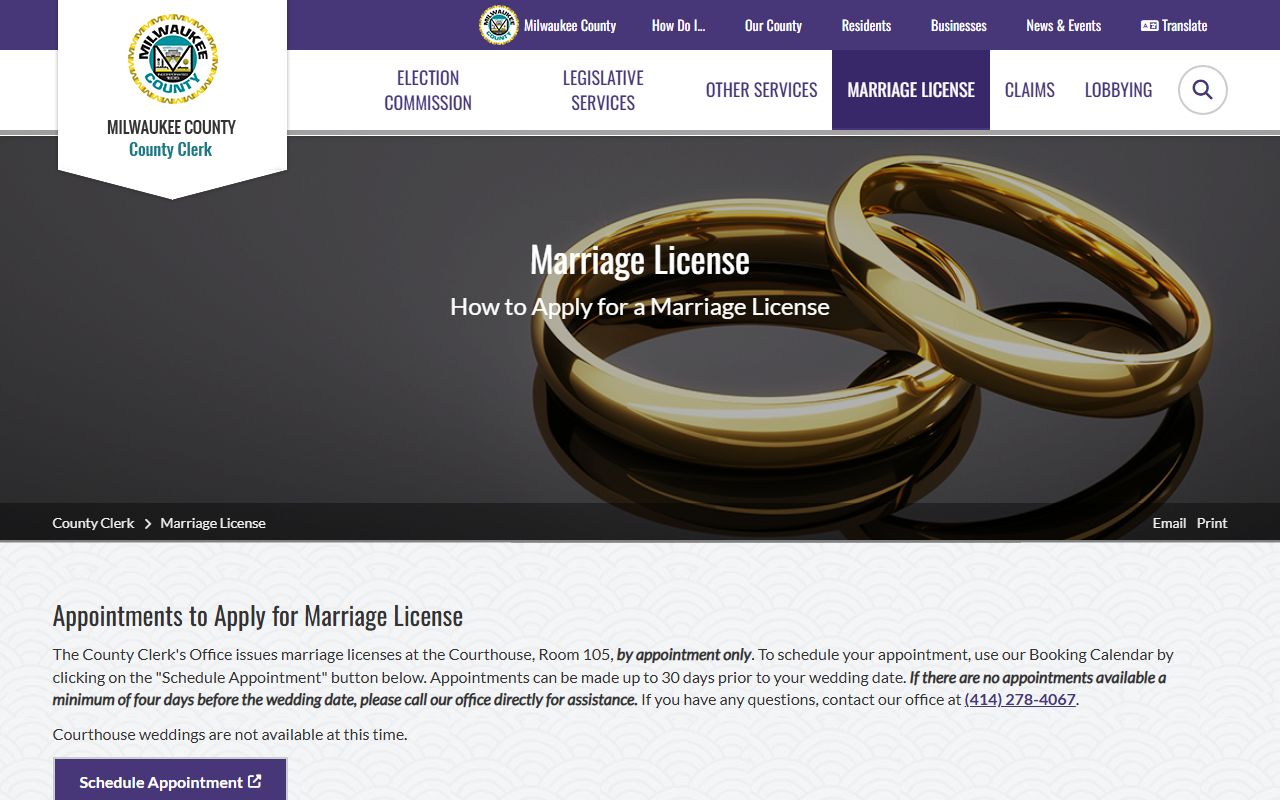
The County Clerk marriage license page lists the appointment tool, the fee, and the documents each applicant must bring.
Each applicant brings a photo ID, a certified birth certificate or accepted substitute, proof of residency, a Social Security number if they have one, a prior marriage termination document if applicable, and the officiant's details. Non-English documents need a certified, notarized translation, and applicants may not translate for each other.
Courthouse weddings are not available at this time, so the clerk can provide a list of officiants. The full marriage and divorce process sits on the marriage and divorce records page.
County Board, Ordinances, and County Records
The County Clerk is the keeper of county government records. It records County Board proceedings and maintains the legislative files behind them. It updates and publishes county ordinances online. It receives bids and claims against the county and keeps contract records.
So a person looking for a county ordinance, a board action, or a claim record goes to the County Clerk, not the court. These are administrative public records, open under Wisconsin's records law. The clerk also publishes the county ordinance code online, which makes it easy to look up a current rule before filing a request. The public records page covers how to file a request for the rest.
Passports and Other County Clerk Services
The County Clerk offers services that surprise people. It accepts passport applications by appointment. It registers lobbyists and lobbying principals. It sells transit fares and Department of Natural Resources licenses and permits. It administers oaths for public officers.
None of these touch court case files. They are county administrative functions placed in the clerk's office. For a court record, the office to use is the Clerk of Circuit Court, a separate office covered below.
The Milwaukee County Register of Deeds
The Register of Deeds issues certified vital records and records land documents. Vital records include certified birth, death, marriage, divorce, and domestic partnership certificates. The office is in Room G6 of the courthouse and can be reached by phone for general and genealogy questions.
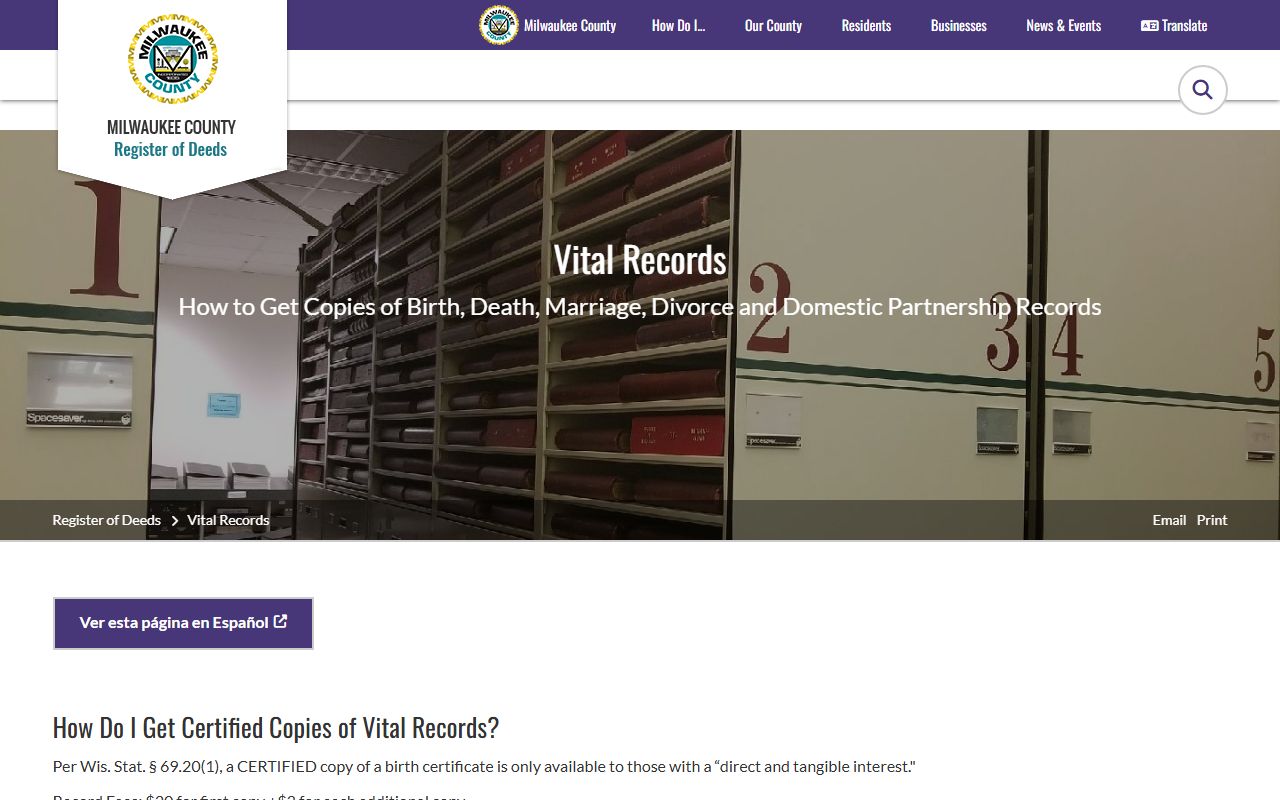
The Register of Deeds vital records page explains the mail, in-person, and online order methods and the certificate fees.
Register of Deeds, Vital Records
County Courthouse, Room G6
901 N. 9th Street
Milwaukee, WI 53233
(414) 278-4021
Genealogy line: (414) 278-4027
Mon-Fri, 8:00 a.m. to 4:00 p.m.
Vital Record Fees and How to Order
Certified vital records carry set fees. The first certified copy is $20, and each added copy is $3. An in-person order has a $3 service fee. Orders can be made by mail, in person, or online, and a mail order needs a valid photo ID.
| Item | Fee |
|---|---|
| First certified copy | $20 |
| Each additional copy | $3 |
| In-person order service fee | $3 |
| Marriage license (County Clerk) | $120 |
Certain certified records require a direct and tangible interest, so the office may ask how you are connected to the record before issuing it.
Vital Record Date Ranges and Genealogy
Date limits decide what the county can issue. The county can issue birth certificates from October 1, 1907, death certificates from September 1, 2013, and divorce certificates from January 1, 2016. Marriage certificates for all recorded events are available in the office. Domestic partnership records come only from the county where the event took place.
Genealogy reaches back much further. Birth records run from the 1850s, death records from 1872, and marriage records from the 1830s. Genealogy visits report to Room G6 and should be scheduled by phone or email. Older divorce records, before 2016, go through the Clerk of Courts civil records process instead.
Note: A marriage license comes from the County Clerk, but a certified marriage certificate after the wedding comes from the Register of Deeds.
How to Order a Milwaukee County Vital Record
Ordering a certified vital record is straightforward once you know the office. The Register of Deeds issues the certificate, and you choose mail, in person, or online. Have your ID ready, since a mail order requires a valid photo ID.
- Confirm the event falls within the county's issuing date range.
- Gather a valid photo ID, required for mail orders.
- Choose mail, in-person, or online ordering.
- Pay $20 for the first copy and $3 for each added copy.
- For genealogy, call ahead and report to Room G6.
For certain records, the office may ask about your direct and tangible interest before it issues a certified copy.
Recorded Land Documents
The Register of Deeds does more than vital records. It records and keeps land and property documents, such as deeds and other recorded instruments. These recorded documents form the official county record of property transfers and interests. A title or property question often starts at this office.
Recorded documents are separate from court case files and from vital certificates. So a property deed, a marriage certificate, and a divorce judgment are three different records from up to three offices. The routing rule stays the same across the county: match the record to the office that creates and keeps it.
Why the County Clerk Handles So Much
The County Clerk office can feel like a catch-all, and there is a reason. As the county's central administrative clerk, it holds the records of county government and the public-service functions that do not belong to a single department. That is why marriage licenses, passports, bus fares, and ordinance publishing all sit under one roof.
For the public, the takeaway is simple. If a record is about county government business or a marriage license, the County Clerk is the likely office. If it is a certified life-event certificate, the Register of Deeds is the office. If it is a court case, the Clerk of Circuit Court is the office.
County Clerk vs Clerk of Circuit Court
This distinction trips up many people in Milwaukee County. The County Clerk and the Register of Deeds keep marriage, vital, and county government records. The Clerk of Circuit Court keeps court case files and issues certified court copies. They share the courthouse, but they are different offices with different records.
So a divorce case file is a court record from the Clerk of Circuit Court, while a divorce certificate is a vital record from the Register of Deeds. A marriage license is a County Clerk record, while a marriage certificate after the wedding is a Register of Deeds record. The Clerk of Circuit Court page covers the court side.