
The Milwaukee County Clerk of Circuit Court
Anna Maria Hodges is the Milwaukee County Clerk of Circuit Court and Director of Court Services. She was elected the 30th Clerk of Circuit Court on November 8, 2022. Her background includes service as Acting Clerk, Chief Deputy Clerk, and Civil Division Administrator, with more than 30 years of public service.
The dual title matters. As an elected constitutional officer and Director of Court Services, the clerk oversees recordkeeping, clerical support, fiscal administration, jury management, and court-service administration. That is why the office reaches well beyond a normal records counter.
Clerk of Circuit Court, Civil Division
901 North 9th Street, Room 104
Milwaukee, WI 53233
(414) 278-5362
General questions: (414) 278-4190
Mon-Fri, 8:00 a.m. to 4:30 p.m.
Clerk of Circuit Court Divisions
The clerk's public work is split across three divisions in three buildings. This is the courthouse's three-door pattern in action. Knowing the right division before you go saves a wasted trip.
- Criminal Division - Safety Building, 821 W. State St., Room 117; felony, misdemeanor, and criminal traffic.
- Civil Division - Courthouse, 901 N. 9th St., Room 104; civil, family, small claims, eviction, paternity, and divorce.
- Children's Court Division - Vel R. Phillips Youth and Family Justice Center, 10201 W. Watertown Plank Rd., Room 1530, Wauwatosa.
Divisions are generally public-facing from 8:30 a.m. to 4:30 p.m. The Jury Management Office also sits under the Clerk of Circuit Court.
Case Volume and Budget
The scale of the office explains its reach. The Clerk's Office processes about 150,000 case files each year. It employs nearly 300 public servants. It administers a budget of more than $42 million. Milwaukee County is the state's largest circuit, with 47 judges, so the clerk's caseload is the heaviest in Wisconsin.
That volume is why the clerk runs as a full service administration rather than a single filing window. Each division handles its own intake, records, and copy requests for its case types.
How to Request a Certified Copy
A certified copy is the official, court-stamped version of a record. You need it for court, employment, immigration, or licensing. A screen print from the state portal is not certified. Each division handles certified copies for its own case types.
- Find the case number on the state portal or your court notice.
- Pick the right division: Criminal, Civil, or Children's Court.
- Complete the matching request form and name the documents.
- Submit in person or by the listed method, and pay the copy fee.
- Add certification, which carries an extra fee on top of the copy cost.
Criminal copies are available from the Safety Building Room 117 window, and older offsite files can take two to three days to pull.
Bring what speeds the request. A case number is the single most helpful item, since staff can find a file fastest with it. Bring a photo ID and a payment method for copy and certification fees. If you cannot come in person, ask the division about mailing a request, and be specific about the documents and whether you need certification. A clear request with a case number almost always returns the right file the first time.
Clerk of Circuit Court Request Forms
The office uses separate forms for civil and criminal records. Both collect the case number, the requester contact, and the documents needed. Being specific about document names speeds the response.
| Field | What It Collects |
|---|---|
| Case number(s) | The Milwaukee County case to locate. |
| Search name(s) | Party names for a criminal records search. |
| Documents requested | Complaint, court record, or judgment of conviction. |
| Requester contact | Name, address, and phone or email. |
| Certification | Check if a certified copy is needed. |
The For-Attorneys resources page collects civil scheduling, subpoena, divorce-by-affidavit, probate, and criminal forms in one place.
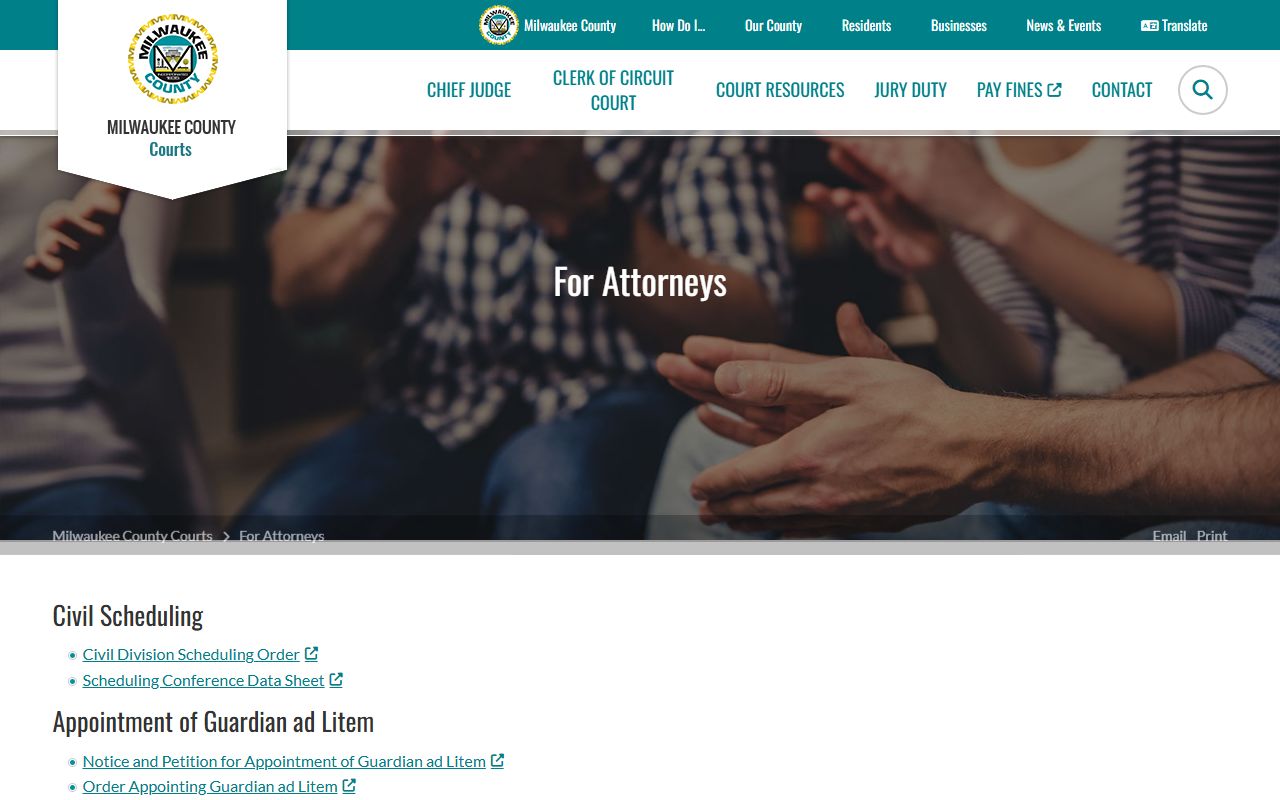
The Clerk's For-Attorneys page links the forms and procedures used across the circuit court divisions.
Clerk of Circuit Court Fees
Copy and filing fees are set by record type and statute. The table below lists the common clerk charges. A circuit e-filing fee applies to many case types under state law.
| Item | Fee |
|---|---|
| Criminal case copy | $1.25 per page |
| Criminal certification | $5 plus copy costs |
| Civil circuit e-filing fee | $20 per party where it applies |
| Small claims filing | $98 |
| Sheriff service for small claims | $75 per person |
The e-filing and clerk fees connect to Wis. Stat. § 801.18 for electronic filing and the clerk-duties statute that governs the office.
Jury Management
The clerk also runs jury duty for the county. The Jury Management Office sits under the Clerk of Circuit Court. It summons jurors, manages the jury pool, and supports trials across the divisions. A person summoned for jury duty in Milwaukee County deals with this office.
Because Milwaukee is the state's largest circuit, the jury operation is large. The clerk coordinates jurors for criminal and civil trials in the busiest trial court in Wisconsin.
The Clerk and the State Case Portal
The Clerk of Circuit Court is the official recordkeeper. Wisconsin Circuit Court Access, or WCCA, is a public window into the case data, but it is not the official judgment and lien docket. The clerk holds the official files and issues certified copies.
So the portal and the clerk work together. Use WCCA to find a case and read a summary, then go to the clerk for an official copy. The court records page covers the WCCA search, and the court dockets page covers reading the case timeline.
Clerk of Circuit Court vs County Clerk
This is the distinction people miss most. The Clerk of Circuit Court handles court case files. The County Clerk handles marriage licenses, county board proceedings, contracts, bids, claims, ordinances, lobbyist registration, and passports. The Register of Deeds handles certified vital records and recorded documents. They are three different offices.
So a court judgment comes from the Clerk of Circuit Court, a marriage license comes from the County Clerk, and a certified birth or death certificate comes from the Register of Deeds. The County Clerk and Register of Deeds page covers those non-court records.
What the Clerk's Office Cannot Do
The clerk's office has firm limits. Staff cannot change a court date, and missing a date can lead to a warrant. Staff cannot give legal advice or predict how a case will come out. They can provide records, procedural information, and the right forms, but the legal decisions stay with the judge, the commissioner, or your attorney.
Knowing these limits helps you ask the right question. For a date change, contact the court or your lawyer. For legal advice, use an attorney or a legal-aid clinic. For a record or a form, the clerk is the right office. The clerk also posts a scam alert about fake traffic-payment messages, so use only official payment links.
Self-Help and Interpreter Services
The clerk's resources link several support services. Court Interpreter Services help people who do not speak English, and a request should be made before a hearing. Family Court Mediation Services handle custody and placement mediation. The Milwaukee Justice Center and the Milwaukee County Law Library help self-represented people with forms and procedure.
These services sit alongside the clerk, not inside it. They exist because the clerk cannot give legal advice, so the county routes self-help and language support to dedicated programs. The public records page lists more legal-aid options, and the FAQ answers common clerk questions.